
Skip to content
C-MOTIONACADEMY
Driving Technique · Driver Development

TheSim RacingSkills Roadmap

Build the right skills in the right order.
CHRIS STEINER  ·  4400 iRating

Sequence beats talent.

This roadmap is built on one simple truth: advanced precision is unreliable when the fundamentals are unstable. The most dependable tenths usually come from vision, reference points, line choice and clean inputs, not from special tricks.

Every skill here can be checked. Not “drive with more feel”, but something concrete: what it looks like in the car, how it feels when it is working and what to verify in your data.

How to read the roadmap
Needs workWhat you notice when the skill is still missing or inconsistent.
Dialled inWhat changes when the skill becomes reliable and repeatable.
Telemetry checkWhat to look at in the data to confirm the pattern.
IMPORTANT: Start with Level 1 before forcing Levels 2 and 3. Even if you consider yourself advanced: when vision, reference points and line choice vary, trail braking, balance and setup work become unreliable.
Want a PDF copy?

Enter your email and I will send you the complete roadmap to save, revisit and print.

Entry, apex and exit

Before the rest of the roadmap makes sense, these are the three phases every corner is built around.

EntryCorner entry

The phase from braking into turn-in: you prepare the speed, balance and direction the car needs for the corner.

ApexClipping point

The point on your chosen line where you are closest to the inside of the corner. Depending on the corner, it may be early, classic or late.

ExitCorner exit

The phase after the apex: you unwind the steering, use the available track and build power without losing the line.
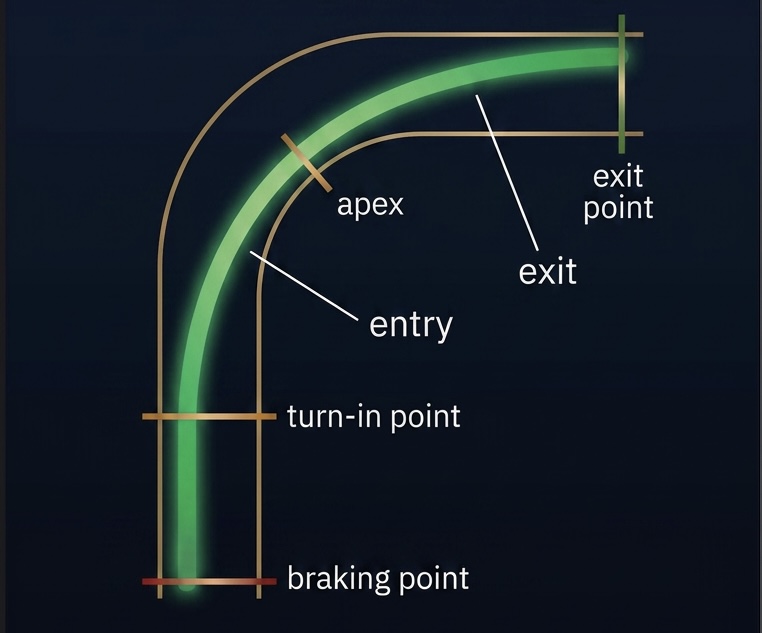
Rule of thumb: “slow in, fast out” is often useful, but not always. What matters is what comes next. If a long full-throttle section follows, protecting the exit is usually the priority.
Corner line showing braking point, turn-in point, entry, apex, exit and exit point
Entry · Apex · Exit The three phases every corner is built around.
Level 1Fundamentals · confidence and consistency
01

Vision and looking ahead

See the braking point, apex, exit and traffic early enough to plan your next input instead of reacting late.
Needs work
  • You react late, make frequent corrections and always feel one step behind the corner.
  • You stare at the car ahead or the apex for too long and lose sight of the exit.
Dialled in
  • You identify the braking point, apex, exit and nearby cars earlier.
  • Your braking points, lines and race decisions become more stable.
  • You free up mental capacity for balance, pace and racecraft.
TELEMETRY CHECK · Telemetry cannot prove where you looked. Watch for steering spikes, late turn-in and inconsistent apex or exit positions.
02

Reference points

Use clear braking, turn-in, apex and exit references instead of estimating the corner from scratch every lap.
Needs work
  • Your braking point moves from lap to lap.
  • Sometimes you hit the apex cleanly; sometimes you miss it without knowing why.
Dialled in
  • Your laps become even and repeatable.
  • Mistakes become visible, measurable and easier to correct.
TELEMETRY CHECK · Compare braking position, pressure build-up and brake release across 5-10 laps. Large variation usually points to weak reference points.
03

Line choice

Choose the line through entry, apex and exit that produces the best total outcome, not just the prettiest middle of the corner.
Needs work
  • You turn in too early and pinch the apex, which compromises the exit.
  • You use the same line regardless of car, grip or weather.
  • You become vulnerable on the following straight.
Dialled in
  • You adapt the line to the car, next corner, grip level and traffic.
  • You deliberately sacrifice one exit when the next corner or race situation requires it.
  • You can use alternative lines in traffic and rain.
TELEMETRY CHECK · Judge the line using delta from turn-in to the next braking zone. Exit speed alone does not tell the full story.
04

Recognising understeer

Feel when the front tyres are saturated and additional steering angle no longer creates additional rotation.
Needs work
  • You notice the front washing wide too late and keep adding steering.
  • The car opens the line unexpectedly and you lose track position or exit speed.
Dialled in
  • You reduce speed or steering angle instead of forcing more lock.
  • The front axle becomes predictable and the corner radius becomes manageable.
TELEMETRY CHECK · Steering angle rises while yaw rate and lateral acceleration barely respond and speed drops: the front axle is saturated.
Level 2Balance and pace
05

Trail braking

Reduce brake pressure smoothly into the turn-in phase to manage front grip, rotation and stability.
Needs work
  • You release the brake abruptly or turn with too much remaining brake pressure.
  • Late braking creates instability because brake release and steering input do not work together.
Dialled in
  • You control the transition from braking to turning.
  • Small braking-point errors no longer destroy the apex or exit.
TELEMETRY CHECK · Check brake release, steering angle, minimum speed and rotation. Good trail braking reduces pressure progressively without a late snap or push.
06

Weight transfer

Understand how braking, throttle and steering move load between the front, rear, inside and outside tyres.
Needs work
  • The balance seems to change randomly.
  • You fight the car instead of using its movement.
Dialled in
  • You use braking, coasting and throttle to create or calm rotation.
  • The car becomes more predictable.
TELEMETRY CHECK · Read longitudinal and lateral acceleration together with your inputs. Sharp transitions reveal where weight transfer is upsetting the car.
07

Controlling oversteer

Recognise rear slip early and control it without sacrificing the entire exit.
Needs work
  • You panic as soon as the rear starts to rotate.
  • Your corrections are abrupt and too large.
Dialled in
  • You can carry more speed with confidence.
  • You approach the limit calmly and catch brief over-rotation without drama.
TELEMETRY CHECK · Check countersteer, steering unwind, throttle and yaw-rate spikes on exit. Excess correction costs traction and straight-line acceleration.
08

Throttle application

Build power as early as the corner allows without overloading the line, rear tyres or available traction.
Needs work
  • The line opens or the rear becomes loose as you accelerate.
  • You have to lift or correct again on exit.
Dialled in
  • The car remains stable to the end of the corner and uses the track cleanly.
  • You build exit speed consistently without stacking corrections.
TELEMETRY CHECK · Compare throttle pickup, lifts, wheelspin or traction-control activity and exit delta. Early full throttle only matters when the car can carry it.
Level 3Precision
09

Brake bias

Use brake bias deliberately to fine-tune entry stability and rotation for the car, corner and stint conditions.
Needs work
  • You compensate for balance problems only with driving style when a small brake-bias change could help.
  • Consistency fades over a long stint.
Dialled in
  • You adjust balance for the car, corner type, tyre wear and fuel load.
  • You know when front or rear stability matters more.
TELEMETRY CHECK · Log brake bias, pressure, ABS or lock-up, entry rotation and exit stability. Change bias only in response to a specific symptom.
10

Corner speed

Choose a speed that still lets the car rotate, hit the apex and accelerate cleanly on exit.
Needs work
  • Sometimes you are too cautious on entry; other times you carry too much speed.
  • You gain a little in the middle of the corner and lose it again on exit.
Dialled in
  • You find a repeatable speed window for entry, apex and exit.
  • You understand when more corner speed helps the exit and when it destroys it.
TELEMETRY CHECK · Compare speed at several points: entry, apex, first throttle and exit. Use your own best laps or a faster driver only under comparable track, fuel, tyre, setup and traffic conditions.
11

Driving a neutral balance

Balance the car so neither axle is consistently overloaded and the available grip is shared effectively.
Needs work
  • One axle is usually overworked: either the front pushes or the rear is doing too much.
  • Grip is left unused because balance and inputs do not match.
Dialled in
  • You use more of the available grip without unnecessary sliding.
  • You carry strong corner speed without sacrificing the exit.
TELEMETRY CHECK · Compare steering angle, yaw rate, lateral acceleration and speed loss. A well-balanced car needs fewer corrections at a high grip level.
12

Understanding setup influence

Know which setup change affects which behaviour and recognise when the real limitation is still driving technique.
Needs work
  • You confuse driving errors with setup problems or copy setups blindly.
  • You change several things at once and cannot tell what helped.
Dialled in
  • You describe one specific problem and test one relevant change.
  • You can separate driving technique from setup behaviour.
TELEMETRY CHECK · Change one item, keep conditions comparable and run 3-5 clean laps against a baseline. Judge average pace, variation and tyre behaviour, not one hot lap.

What this roadmap is built on

The roadmap is deliberately practical. Its technical foundation comes from vehicle dynamics, tyre modelling, optimal control and research into visual guidance. Practical driving books help with language and application, but they do not replace the physics.

Milliken & Milliken “Race Car Vehicle Dynamics”: tyres, load transfer, balance and race-car dynamics.
Thomas D. Gillespie “Fundamentals of Vehicle Dynamics”: the foundations of braking, steering, wheel load and stability.
Hans B. Pacejka “Tire and Vehicle Dynamics”: slip angle, tyre force, combined slip and the operating limits of the tyre.
Land & Lee / Lappi Research on gaze behaviour in corners: drivers look ahead and use the tangent point and future path rather than staring directly in front of the car.
Velenis, Tsiotras & Lu Trail braking and aggressive manoeuvres as an optimisation problem: braking, steering and load transfer interact.
Practical reading Skip Barber “Going Faster!”, Ross Bentley “Speed Secrets”, Carroll Smith “Drive to Win” and Adam Brouillard “The Perfect Corner” as accessible application-focused references.

These are 12 skills.

How many can you rely on in every car, on every track?

Honestly? Many sim racers can rely on only three or four of them. The rest works only while the car, track and grip level stay familiar.

That is rarely a talent problem. More often, the missing piece is the right learning order and a debrief based on your own data, not another generic instruction to brake later.

TELEMETRY QUICKSCAN
Upload one representative stint and receive a personal recorded debrief with three clear priorities.
69 €
PERFORMANCE DIAGNOSTIC
60 minutes live: telemetry debrief and on-track coaching with me on Discord.
159 €
DRIVER DEVELOPMENT SPRINT
A programme over 6 to 8 weeks with four live sessions, a personal plan and progress checks.
559 €
Find the right coaching option →
CHRIS STEINER  ·  4400 iRating  ·  C-MOTION ACADEMY